-
#TeachersOfTikTok - From Hashtags to Habits: Social Media's Influence on Teacher Identity, Practice, and the Role of Teacher Preparation Programs (Chapter from Exploration of K-12 Teaching and Learning Teacher Educators)
Martha A. Wilkins and Danielle Ligocki
Social media, particularly TikTok, has become a major influence on pre-service teachers (PSTs), shaping their professional identity, pedagogical expectations, and instructional decision-making. While TikTok offers networking and inspiration, its algorithm-driven content prioritizes entertainment over evidence-based pedagogy, reinforcing idealized, oversimplified, and commercialized portrayals of teaching. Many PSTs consume and apply TikTok-derived strategies without critical evaluation, contributing to the casualization and deprofessionalization of the profession. Ethical concerns, including student privacy, influencer-driven monetization, and digital professionalism, further complicate its role in teacher education. Grounded in Critical Media Literacy (CML) and Critical Discourse Analysis (CDA), this study argues for explicit media literacy training in teacher preparation programs to help PSTs critically engage with social media and distinguish between entertainment-driven trends and credible pedagogical knowledge.
-
Introduction to our research, framing constructs, and purposes (Chapter 1 from Affirming the Rights of Emergent Bilingual and Multilingual Children and Families: Interweaving Research and Practice through the Reggio Emilia Approach)
Brenda Fyfe, Yin Lam Lee-Johnson, Juana M. Reyes, and Gigi Schroeder Yu
The co-editors present an introduction to key concepts and constructs that guided the writing and research discussed in this book. The book focuses on distinctive features of the Reggio Emilia philosophy that are particularly suited to support language and social development of emergent bilingual and multilingual learners and their families, in particular the theory of the hundred languages, a concept that gives value and dignity to all the verbal and non-verbal languages of children and adults; a pedagogy of listening and relationship; learning as an individual and group construction; shared research between adults and children; observation, documentation, and interpretation of children’s individual and group strategies and processes to inform the planning and design of long-term investigations; participation of families and communities; and ongoing professional development of educators. The multiple authors in this edited book advocate for having a transformative lens that values the linguistic and cultural repertoires of learners who speak different languages at home other than at school. Their intent is to inform and provoke conversation among educators, families, and the community about how early education can affirm the rights of minoritized emergent bi- and multilinguals and by doing so, ensure the rights of all emergent language learners.
-
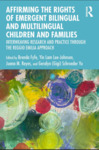
Moving the conversation forward (Chapter 15 from Affirming the Rights of Emergent Bilingual and Multilingual Children and Families Interweaving Research and Practice through the Reggio Emilia Approach)
Brenda Fyfe, Gigi Schroeder Yu, Juana M. Reyes, and Yin Lam Lee-Johnson
Through each chapter of this book, we advocated for a transformative lens on early childhood education which values the linguistic and cultural repertoires of learners who speak different languages at home other than at school. In this final chapter, we highlight select findings from the research and practice examined in our book that we believe can move us forward and push the boundaries of our conversation about supporting the rights of emergent bilingual and multilingual learners and families. We challenge the traditional approach of highlighting English as the target language in the classroom, while sacrificing the cultural and linguistic rights of children and their families. We unravel the whitewashedness and middle-class White privilege that penetrates our early childhood centers. We challenge the covert and overt hidden curricular assumption of English being the most important object of learning, which ignores the need for validating the family literacy and home languages of children. We recognize and encourage more research on the critical importance of teaching with cultural humility and being mindful about unconscious bias and stereotyping. Furthermore, we must confront racist, reductionist, and deficit perspectives regarding cultures and languages. We aim to push the boundaries of our thinking, our theories of change, and our theories of learning by challenging ourselves to consider radical change, as Lee-Johnson stated in Chapter 10, to contest inequities that exist in the power structure and hierarchies of our typical U.S. contexts.
-
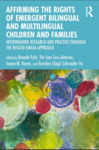
What does it mean to be emergent bi-and multilingual language learners? Self-stories and counternarratives from educational researchers (Chapter 12 from Affirming the Rights of Emergent Bilingual and Multilingual Children and Families Interweaving Research and Practice through the Reggio Emilia Approach)
Juana M. Reyes, Nahid Nader-Hashemi, and Yin Lam Lee-Johnson
In this chapter, the authors advance the definition of emergent bi- and multilingual learners by first defining the limitations of the terminology ELL. Next, they define an ecological perspective toward human development that recognizes the role of context in language learning and development. Additionally, the authors discuss their experiences with language learning within their own family structures. Through self-stories and counternarratives, this chapter investigates the notions that revolve around emerging bilingual and multilingual language learners in early education with particular emphasis on children zero to six years of age. The co-authors discuss their language learning experiences within their family structures. These stories counter the White gaze of White Mainstream English (WME) as dominant and recenter the gaze upon a narrative of raciolinguistic justice originally seeded in our family stories. We came together as bi- and multilingual mother/grandmother scholars to weave our narratives and add our voices to the counternarrative tradition using a critical lens to frame and reflect upon our stories.
-
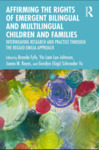
Words unspoken: The radical pursuit of culturally relevant and culturally sustaining pedagogical documentation (Chapter 7 from Affirming the Rights of Emergent Bilingual and Multilingual Children and Families Interweaving Research and Practice through the Reggio Emilia Approach)
Juana M. Reyes and Gigi Schroeder Yu
Having worked in neighborhoods known as ports of entry for immigrant and refugee children and families in Chicago, the authors learned that for immigrant and refugee communities, documentation holds a very different meaning. That is, having documentation implies having papeles to be in the United States. Consequently, documentation in the form of assessment and evaluation in school settings for immigrant and refugee children has been about defining who they are and who they are not using a monoglossic ideology that embraces what is termed in recent years academic English. This yields English spoken by whites as the default, the normal as it others, devalues, and labels emergent bi- and multilingual children as being deficient, at risk, and deviating from the norm. Therefore, using terms such as English proficient, English learners, and English language learners are rooted in the desire to uphold English as the norm. In their work on polylanguaging, other researchers emphasize the fluidity of language as they challenge the widely held notion that languages are separate entities. They take exception to the notion that languages can be counted, e.g. I speak two languages: French and German. Perhaps the concept of polylanguaging invites us to consider the dynamic and fluid nature of language and to abandon the antiquated notion that languages are independent and static. In the traditional view of languages, there is a hierarchy of languages in which many languages are seen as less than others or completely unrecognized as languages.
-
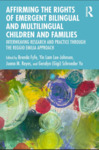
The metaphorical context of the atelier as a border crossing space: Exploring relationships in young children's languaging and translanguaging processes (Chapter 11 from Affirming the Rights of Emergent Bilingual and Multilingual Children and Families: Interweaving Research and Practice through the Reggio Emilia Approach)
Gigi Schroeder Yu, Yin Lam Lee-Johnson, and Juana M. Reyes
The context of the atelier promotes the culture of imagination and creativity as an integral aspect of learning. Notable is the potential of the atelier as a motivator for change, not just as a physical space but also for conceptually promoting new ways of doing school, beyond an emphasis on reading, writing, and mathematics. In this chapter, three teacher educators representing distinct disciplines of art education, TESOL, and early childhood bilingual education, reflect on and interpret the context of the atelier as a space for the border crossing of languages and transdisciplinary research. Border crossing is a construct that denotes crossing over and in/between a hundred languages during the meaning-making process. The atelier is a context for the interconnected nature of languages and for approaches that contribute to transdisciplinary and translanguaging possibilities. In the final section, the authors highlight the atelier as an intersection of their fields of knowledge and what this might offer teacher education programs.
-
Breathing new life: The graphic languages, translanguaging, and metaphoric language with young children in multilingual contexts (Chapter 3 from Affirming the Rights of Emergent Bilingual and Multilingual Children and Families: Interweaving Research and Practice through the Reggio Emilia Approach)
Gigi Schroeder Yu and Juana M. Reyes
In this chapter, the authors focus on the theoretical aspects of graphic languages within the Reggio Emilia Approach and multilingual contexts of Reggio Emilia infant-toddler centers and preschools and U.S. Reggio-inspired schools. A brief historical overview describes the value of drawing cultivated by Loris Malaguzzi and the Reggio Emilia educators over decades. The theories of the hundred languages, languaging , and translanguaging pedagogy present an invitation to consider a broader interpretation of what language can become. The relationship between drawing and verbal language as action processes to create meaning within the bi-, multilingual context strengthens the potentialities of translanguaging. The concept of small group learning within Reggio Emilia pedagogies parallels the translanguaging space as generating new possibilities and co-constructed meanings and realities. The authors advocate for more research on drawing in bilingual and multilingual settings, including serious studies of the drawing-as-language phenomenon . While drawing is usually in service to language learning as an add-on activity, the authors propose that it should be considered essential in translanguaging and interwoven within the linguistic repertoire of bi-and multilingual children as an opportunity to construct robust and complex meanings.
-
What we learned from our conversation with Reggio educators (Chapter 2 from Affirming the Rights of Emergent Bilingual and Multilingual Children and Families Interweaving Research and Practice through the Reggio Emilia Approach)
Gigi Schroeder Yu, Juana M. Reyes, Yin Lam Lee-Johnson, Brenda Fyfe, and Baji Rankin
This chapter focuses on the researchers’ analyses and interpretations of a two-hour recorded conversational interview conducted with a group of six Reggio educators in May 2019. The conversation was a rare and special opportunity to have a lengthy dialogue with a cross-section of Reggio educators, to ask questions and to learn more about their pedagogical approaches to working with emergent multilingual children and their families. Key concepts and threads of discussion from the interview included the importance of building trusting relationships with children and families who are newcomers, developing their sense of belonging, learning from and with them through the pedagogy of listening, and using the theory of the hundred languages to support non-verbal expression, interactions, shared experience, and, eventually, shared oral language, translanguaging, and exchange. The chapter serves as a springboard for the rest of the book, which further investigates and continues the conversation, the circulation of ideas and multiple perspectives, which help us to understand how to affirm the rights of emergent bilingual and multilingual language learners and their families to high quality early education.
Printing is not supported at the primary Gallery Thumbnail page. Please first navigate to a specific Image before printing.